
%20(1).png?width=1799&height=1201&name=PSIT%20blog%20-%20medium%20Size%20Table%20%20(1897%20x%201300%20px)%20(1).png)

What Is SharePoint? 2025 Guide to SharePoint with AI Copilot & Agents
New to SharePoint and unsure where to start? This guide walks you through the everyday tasks: finding your team’s site, uploading files, sharing documents and working with others.
We’ll start with a few basic terms, then show you how to use SharePoint in Microsoft 365, also called SharePoint Online.
Your organization controls which sites and features you can access. If an option is missing or your screen looks different, your site owner or IT team can help.
SharePoint in Microsoft 365 helps your team store shared files, organize information and work together on documents.
You may already use SharePoint through Microsoft Teams. Files shared in Teams channels live in SharePoint, so you can work with them through either app.
Before you start, it helps to understand a few terms: sites, document libraries and lists. We’ll explain these below.
?
SharePoint is Microsoft’s platform for storing shared documents, creating internal websites and organising information.For example, your team might use SharePoint to keep project files in one place, publish company news or maintain a list of tasks. People with the right access can find information and work together on documents.
This guide focuses on SharePoint in Microsoft 365, which you access through a web browser using your work or school account.
Related blogs you might like:
👉 What is SharePoint? Understand Microsoft SharePoint In Plain English
👉 Why Use a SharePoint Content Management System? A Quick Guide for Executives & Managers
You’ll see these terms as you start using SharePoint:
- Site: A shared place for a team or department’s files, pages and information.
- Document library: A place within a site where you store and organise files. Your team can share documents, edit them together and view earlier versions.
- List: A way to track information in rows and columns, such as tasks, requests or equipment.
- Page: A place to display information, such as team updates, instructions or useful links.
- Web part: A building block you add to a page, such as text, an image or a document library.
- Permissions: Settings that control who can view, edit or manage content.
For example, a project team could use a site for its work, a document library for project files and a list to track tasks.
?
SharePoint helps teams share files, publish information and manage everyday work. Here are some of its main features:
📁 File storage and sharing
Store team documents in document libraries, organise them and work on files together. Permissions control who can view or edit content. Sharing outside your organisation depends on your company’s settings.
✍️ Electronic signatures
If your organisation enables Microsoft 365 eSignature, you can request electronic signatures for supported documents stored in SharePoint. The service requires administrator setup and pay-as-you-go billing.
👥 Team sites and communication sites
Team sites help groups work together on files and projects. Communication sites share news, announcements and resources with a wider audience. Team sites connected to Microsoft 365 groups also provide shared tools such as a mailbox and calendar.
🌐 Pages and web parts
Create pages for team updates, instructions or useful resources. Build each page with web parts, such as text, images, news or a document library.
🧠 Workflows and automation
Use Power Automate with SharePoint to support tasks such as approval requests and notifications. Available options depend on your permissions and licences.
🤖 AI-powered SharePoint agents
Ask questions about the sites, pages and documents included in an agent’s sources. Agents use only information you have permission to access. Using them requires an eligible Copilot licence or access through your organisation’s pay-as-you-go setup. Check important answers against the source documents.
What Is SharePoint Site?
A SharePoint site is a shared space for a team, department or project. It brings together documents, pages and information that people can access based on their permissions.
Within a site, you might find:
- Document libraries for shared files, such as proposals, reports or project documents.
- Lists for tracking information, such as tasks, requests or equipment.
- Pages for displaying news, instructions and useful links.
For example, a project site could include a document library for project files, a list of deadlines and a homepage with updates. Your organisation may already have a site for your team, so check with your manager or IT team before creating another one.ok
?
SharePoint Online and SharePoint On-premise Server are two different versions of SharePoint, each with its own set of features and benefits:
✅ SharePoint Online
Runs in Microsoft’s cloud and is available through eligible Microsoft 365 plans. Microsoft maintains the platform, while your organization manages its content, permissions and settings.
✅ SharePoint On-Premise Server
Runs on infrastructure your organization manages, either itself or through a service provider. Your IT team handles maintenance, updates and the underlying infrastructure.
This tutorial covers SharePoint Online in Microsoft 365. If your organisation uses SharePoint Server, some screens, features and steps may differ.
👉 Related read: Microsoft SharePoint Online vs On-Premises: What's Best for You?
?
SharePoint works with other Microsoft 365 tools , so you can use shared information in the apps your team already uses:
 Microsoft Teams
Files shared in Teams channels live in SharePoint. You can work on the same files through Teams or SharePoint. Files uploaded to Teams chats usually live in the sender’s OneDrive.
.svg.png?width=23&height=15&name=Microsoft_Office_OneDrive_(2019%E2%80%93present).svg.png) OneDrive
OneDrive
Use OneDrive for your individual work files and SharePoint for shared team files. The OneDrive sync app can also sync SharePoint libraries to your computer.
 Outlook
Send links to SharePoint documents through Outlook, instead of separate attachments, so colleagues can work from the same file. They still need permission to access it.
 PowerBI
Display interactive reports on SharePoint pages. Readers need the right Power BI access and licensing to view them.
 Power Apps
Create custom forms for SharePoint lists, such as a form for equipment requests with Power Apps.
 Power Automate
Build workflows that use SharePoint information, such as sending an approval request when someone adds a document.
 Microsoft 365 Copilot
Copilot can help you find and summarise information from SharePoint content you have permission to access. For example, you could ask for a summary of a project document. Availability depends on your organisation’s licences and settings, and you should check important answers against the source.

How to Use SharePoint: Getting Started
Organizations use SharePoint in various ways, and SharePoint itself can encompass many capabilities, making it highly customizable to fit your organization’s needs. However, at its most basic level, here are five things you need to know to start using SharePoint:
Start by finding your team’s SharePoint site and the document library where you should work. You do not need to create a new site to follow this tutorial.
STEP 1
Open Microsoft 365 in your browser and sign in with your work or school account.
STEP 2
Open the app launcher and select SharePoint. If you do not see it, check the full app list or ask your IT team for your site’s link.
STEP 3
Open your team’s site. If you cannot find it, ask your manager or site owner for the direct link.
STEP 4
Select Documents, or the document library your team uses. Library names can vary.
You can also open a SharePoint site from a Teams channel. Open the channel’s shared files area and look for Open in SharePoint.
Before uploading: Confirm that you are in the right library and have permission to add files. If you see an access request, contact the site owner.
Tip 1. How to Upload Files
You can upload files to a SharePoint document library in two ways:
Drag and drop:
- Open the document library and, if needed, the folder where the file belongs.
- Open File Explorer on Windows or Finder on Mac.
- Drag the file into the library in your browser.
- Wait for the upload to finish and check that the file appears.
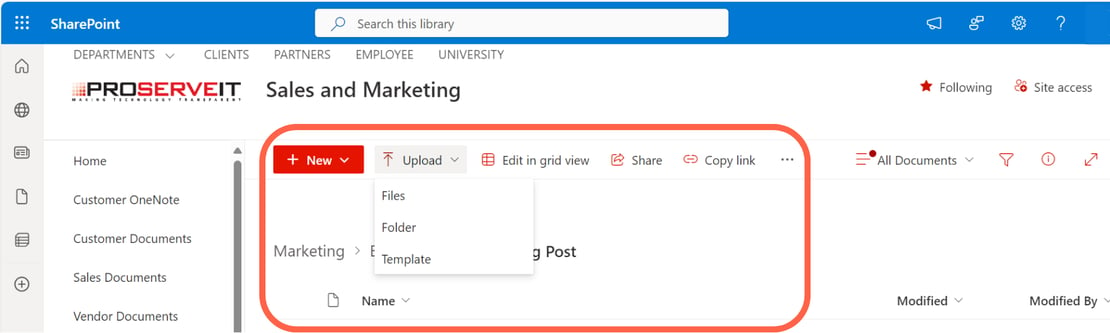
Use the Upload button:
- In the document library, select Upload, then Files.
- Select the files from your computer, then select Open.
- Wait for the upload to finish.
If you cannot upload files, ask the site owner to check your permissions.
📖 See Microsoft’s instructions for uploading files and folders to a SharePoint library.
Tip 2. Opening Documents
Select a document’s name in the SharePoint library to open it. Word, Excel and PowerPoint files can open in your browser or desktop app, depending on your library settings.
To choose how to open a file, select the three dots (…) beside its name, then Open and the available browser or desktop app option. You need the desktop app installed to use it.
You can edit the document if you have editing permission. When editing in the browser, check that your changes have finished saving before closing the tab.
📖 See Microsoft’s instructions for opening and editing documents in a SharePoint library.
%20(1)-1.png?width=1110&height=302&name=PSIT%20blog%20-%20medium%20Size%20Table%20%20(1897%20x%201300%20px)%20(1)-1.png)
Tip 3. Collaborating with Others on a Document
You can work with colleagues on the same Word, Excel or PowerPoint file stored in SharePoint, using apps and file formats that support co-authoring.
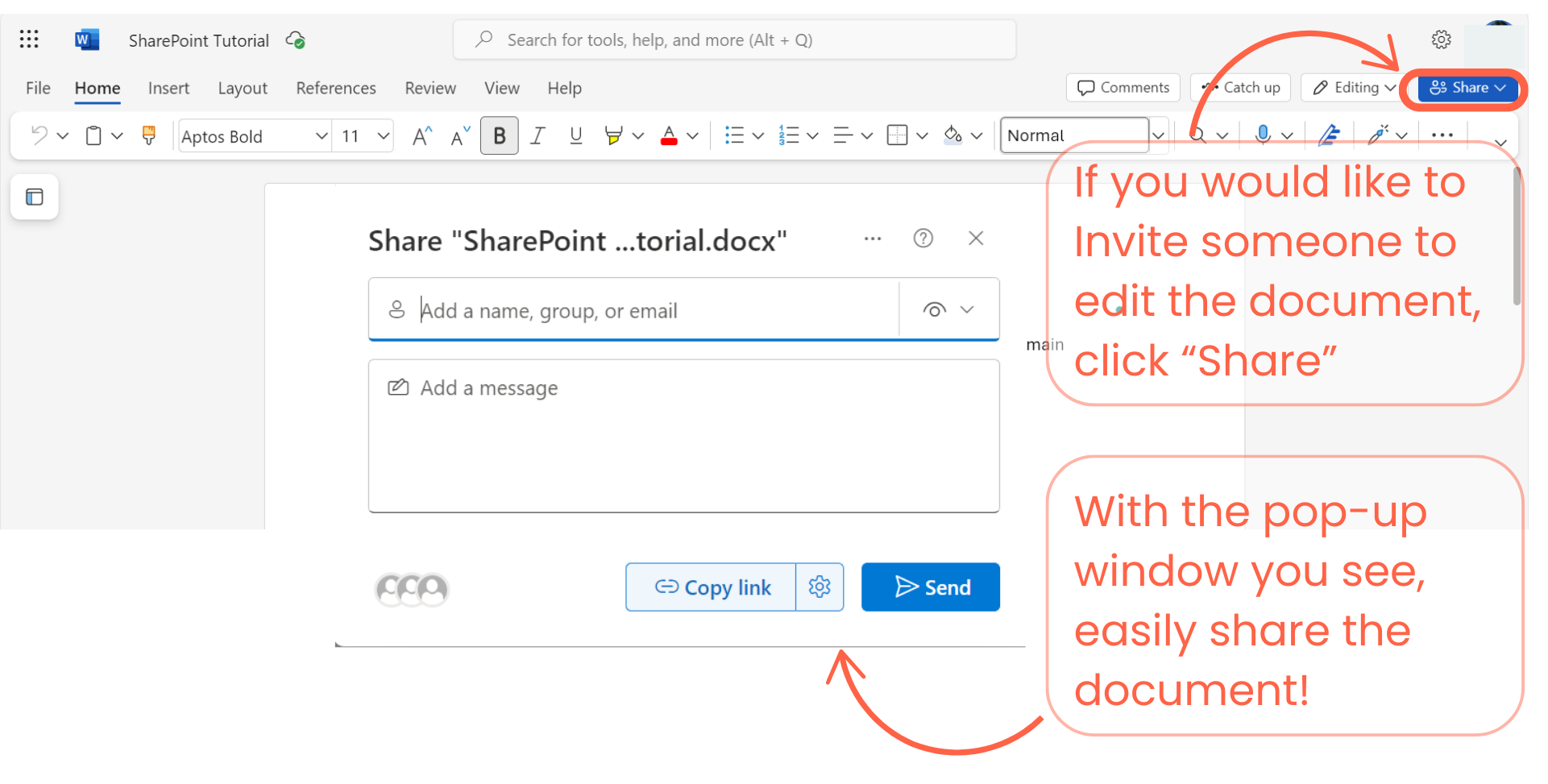
- Open the document.
- Select Share and enter your colleagues’ names or email addresses.
- Check that they have Can edit access if you want them to make changes, then select Send.
- Open the same file to work together. You can see who else is editing and their changes as they happen.
Share a link to the document rather than sending separate copies. If someone cannot edit it, check their permissions or ask the site owner for help.
📖 See Microsoft’s guidance on document collaboration and co-authoring.
Tip 4. Searching for a Document
Use SharePoint search to find documents by their name or by words related to their content.
- Open your team’s site or document library.
- Enter a file name or relevant keywords in the search box.
- Check the search scope. Searching from a site or library can limit results to that location.
- Use the available filters to narrow your results.
If you cannot find a file, check that you are searching in the right place and have permission to access it. Recently uploaded files may take time to appear in search.
📖 See Microsoft’s explanation of modern search in SharePoint.
💡 Use natural-language search
Modern SharePoint experiences and AI-powered agents allow users to ask questions in plain English, such as “Show me the latest marketing plan” or “Summarize our SharePoint governance policy,” helping users find information more quickly.
%20(3).png?width=1110&height=373&name=PSIT%20blog%20-%20medium%20Size%20Table%20%20(1897%20x%201300%20px)%20(3).png)
Tip 5. Copying and Moving Files and Folders
Use Copy to when you want another copy of a file, or Move to when you want to change its location.
- Select the files or folders in your document library.
- Select Copy to or Move to. If you do not see the command, check the three dots (…) menu.
- Choose the destination site, library or folder.
- Select Copy here or Move here, then wait for the action to finish.
Check the destination before you finish. Copy to copies only the latest document version; Move to carries the document’s version history with it. You need suitable permissions for the action and destination.
📖 See Microsoft’s instructions for moving or copying files in SharePoint.
%20(4).png?width=1897&height=996&name=PSIT%20blog%20-%20medium%20Size%20Table%20%20(1897%20x%201300%20px)%20(4).png)
If someone makes an unwanted change, SharePoint’s version history can help you recover an earlier version of the document.
- Find the file in your document library.
- Select the three dots (…) beside its name, then Version history. You may need to look under additional options.
- Review the available versions and open the one you want to check.
- If you have permission, select Restore for the version you want to use.
Restoring a version makes it the current version without deleting the previous history. Check with colleagues before restoring a shared document so you do not replace changes they still need.
If you cannot see version history or restore a version, ask the site owner for help.
📖 See Microsoft’s instructions for restoring a previous document version.
Once you are comfortable with shared files and documents, you can explore newer SharePoint features where your organisation makes them available:
- Microsoft 365 Copilot and SharePoint agents: Ask questions about content you can access, such as “What are the main deadlines in this project?” Check the answer and its sources before relying on it.
- Electronic signatures: Request signatures for supported documents if your organisation has enabled the service. Ask your IT team which process and signature provider your team should use.
These features have separate licensing or setup requirements. You can follow the basic tasks in this guide without using them.
📖 See Microsoft’s guide to getting started with agents in SharePoint.

You do not need to learn every SharePoint feature at once. Start with finding your team’s files, sharing a document and working on it together. Those small tasks will help you get comfortable with the tool.
If something looks different or does not work, ask your site owner or IT team. Your organisation’s settings and permissions can change what you see.
At ProServeIT, we focus exclusively on Microsoft technologies. As a Microsoft Solutions Partner, we work alongside your team to make SharePoint and Microsoft 365 easier to use and manage. That starts with understanding how your people work, where they get stuck and what would help.
Whether you need clearer document organisation, support with permissions or help getting your team comfortable with SharePoint, you do not need to have it all figured out before talking to us.
💬 Talk to ProServeIT about making SharePoint work better for your team.
Frequently Asked Questions (FAQs)

Cassandra is a dedicated content marketer at ProServeIT, specializing in SEO and blending creativity with strategic insight in every project. With a deep passion for technology, particularly in AI and Virtual Reality, Cassandra stays at the forefront of digital advancements, consistently integrating the latest innovations into her work. Her enthusiasm for learning and innovation drives her to push the boundaries of what's possible, helping ProServeIT stay ahead in the ever-evolving tech landscape.


Comments