
Why Managed IT Services Aren't Complete Without Integrated Cybersecurity
Why Today’s Leaders Must Re‑Evaluate Their IT Support Model
Most organizations do not examine their IT support strategy closely until something goes wrong. A system outage disrupts operations. A security incident escalates quickly. A migration fails under pressure. A whole bunch of frustrated employees are left unsupported, which leads to lost productivity.
In those moments, a deeper leadership question often surfaces: are we structured to prevent disruption through proactive IT support, or are we simply structured to respond with reactive IT support?
.png?width=1078&height=277&name=Evaluating%20IT%20models%20(1).png)
A Strategic Decision for Leadership
The distinction between reactive IT support and proactive IT support is not merely operational. It reflects an organization’s broader posture toward risk, leadership accountability, and long‑term technology strategy.
For executives evaluating a managed services provider, understanding this difference is essential because the decision goes a step further than technical brilliance. The key is choosing a strategic IT partner who strengthens the organization’s posture, and delivers true proactive IT support, especially in an era defined by AI acceleration and cybersecurity complexity.
In this blog, we’ll explore:
🛠️ What Reactive IT Support Looks Like
⚙️ What Proactive IT Support Actually Means
🏢 The Organizational Impact of Proactive vs. Reactive IT
📊 The Long-Term Business Cost of Reactive IT Support
🤖 The Age of AI Demands Proactiveness
💡 The Next Layer: A Human-Centered and Hospitality-Driven Approach to Proactive IT Support
🤝 How to Spot an IT Partner Who Delivers True Proactive IT Support
What Reactive IT Support Looks Like
Before talking about proactive IT, it’s worth being clear about the operating model many organizations are still running today.
Reactive IT support operates on a traditional break-fix model.
An issue occurs, a ticket is submitted, and a technician resolves it. Performance metrics typically emphasize response time and resolution speed.
While this model may function adequately in stable environments with limited complexity, it becomes increasingly fragile as organizations adopt cloud platforms, AI tools, remote work models, and expanded cybersecurity managed services.
Why Reactive Models Fail Leaders
In leadership terms, the biggest challenge is not the volume of issues, but the lack of foresight and strategic visibility created by reactive IT support.
In reactive environments:
-
Problems are often identified only after users experience disruption
-
Security vulnerabilities are addressed after alerts escalate
-
Strategic conversations tend to occur infrequently, if they happen at all
-
Long-term roadmaps are either unclear or nonexistent
Although response times may appear efficient on paper, leadership often feels as though they are one step behind emerging risks. The organization expends more energy managing incidents than preventing them.
This tension is one of the key reasons many organizations ultimately shift toward proactive IT support to regain stability and leadership control.
What Proactive IT Support Actually Means
Proactive IT support is not simply faster response. It represents a fundamentally different operating model and IT support strategy.
A proactive managed services provider continuously monitors infrastructure not only for outages, but for patterns and early indicators of risk. Vulnerabilities are assessed before exploitation occurs. Capacity constraints are identified before performance degradation. Technology planning is aligned with business objectives rather than waiting for failure to force change.
In practice, proactive IT support includes:
-
Continuous monitoring with predictive analysis
-
Lifecycle planning for hardware and software
-
Structured strategic reviews
-
Early risk mitigation planning
The objective is not merely to resolve issues efficiently, but to reduce both the likelihood and the impact of those issues altogether.
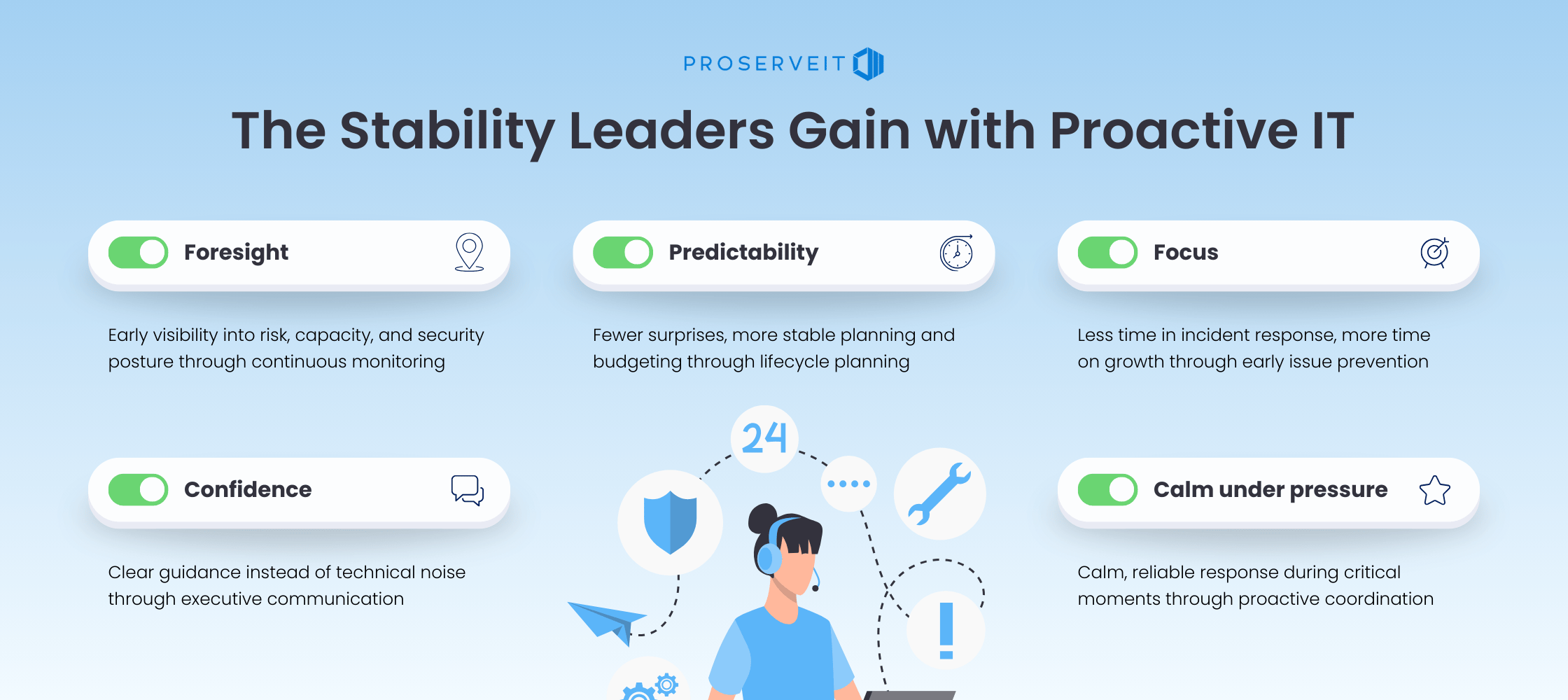
This approach creates a more stable operating environment. Instead of reacting to disruption, leadership can operate with greater foresight and confidence.
Proactive Does Not Mean Bureaucratic
Being proactive does not mean becoming bureaucratic.
It is not about:
-
Excessive roadmap documents
-
Endless scenario modeling
-
Constant speculation about every possible scenario
-
Adding layers of planning for the sake of control
In fact, in the age of AI-driven transformation, organizations cannot afford to become heavy with over-planning.
The pace of technological change is simply too fast. New capabilities emerge rapidly. Threat landscapes evolve continuously. Business priorities shift more frequently than traditional multi-year roadmaps can accommodate.
Agility Is Key
True proactive IT support is disciplined but agile. It balances foresight with flexibility.
It focuses on identifying material risks and meaningful opportunities without becoming paralyzed by exhaustive forecasting.
The goal is not to predict every scenario, but to build systems, monitoring, and governance that allow the organization to adapt quickly when change inevitably arrives.
Proactiveness, at its best, is lightweight but intentional. It provides direction without rigidity and preparedness without unnecessary complexity. It creates the agility organizations need in a rapidly evolving digital landscape.
The Organizational Impact of Proactive vs. Reactive IT
For executive teams, the difference between reactive IT support and proactive IT support translates into measurable organizational impact.
Reactive environments introduce volatility:
-
Leaders are pulled into unexpected incidents
-
Budget forecasts shift due to emergency remediation
-
Strategic initiatives stall because operational fires demand immediate attention
Conversely, proactive IT support fosters steadiness:
-
Risks are surfaced earlier
-
Investment planning becomes more predictable
-
Technology initiatives are aligned with growth objectives rather than dictated by crisis response
This stability influences not only IT performance but also board confidence, employee productivity, regulatory posture, and brand reputation.
Technology risk is business risk. A proactive IT support strategy materially reduces that exposure.
The Long-Term Business Cost of Reactive IT Support
Many organizations tolerate reactive IT support because visible metrics appear acceptable. Tickets are closed. Systems are restored. Incidents are resolved. However, what often goes unmeasured is the cumulative cost of interruption.
-
Lost productivity
-
Delayed initiatives
-
Executive distraction
-
Gradual erosion of confidence in IT leadership
They all accumulate over time.
Reactive models may appear manageable in the short term but become increasingly expensive as preventable incidents recur.
The financial cost of disruption is only part of the equation; the organizational cost is often greater.
A strategic IT partner helps quantify these hidden costs and shifts the conversation from response efficiency to prevention strategy.
Cost Containment Turns Into Strategic Risk
We have consulted many organizations that initially deprioritized proactive IT support as a cost-saving measure, later realizing that the absence of prevention introduced greater operational and financial strain.
Preventive services can look discretionary when budgets tighten, and reactive IT support can seem sufficient if systems are mostly stable.
How the Cost Compounds Over Time
However, over time the hidden costs surface:
-
Incidents become more frequent
-
Strategic initiatives slow because internal teams are consumed by unplanned disruptions
-
Security exposure increases quietly
-
Leadership attention is diverted from growth to remediation.
The cumulative effect is rarely dramatic in a single moment, but it compounds. What began as cost containment turns into operational volatility and higher long-term expense.
There is a real cost to staying reactive IT support. It is simply less visible at the outset.
The Age of AI Demands Proactiveness
This conversation becomes even more urgent in the current era of AI-driven acceleration.
Artificial intelligence is reshaping workflows, expanding threat surfaces, and increasing the velocity of technological change.
New tools emerge rapidly. Security implications evolve continuously. Regulatory scrutiny grows alongside innovation.
In this environment, it is difficult for internal teams to keep pace with both operational demands and emerging cybersecurity risks.
Waiting to respond after disruption is no longer viable. Proactiveness has moved from operational preference to strategic necessity.
Organizations increasingly need managed services providers who are:
-
Scanning ahead
-
Interpreting technical shifts
-
Evaluating emerging cybersecurity threats
-
Translating complexity into actionable guidance.
A reactive IT support model cannot keep pace with AI-driven transformation. Proactive IT support provides the foresight required to operate confidently in a rapidly evolving landscape.
.png?width=2240&height=1000&name=How%20Proactive%20IT%20Enables%20Leaders%20(1).png)
The Next Layer: A Human-Centered and Hospitality-Driven Approach to Proactive IT Support
Where Proactive Support Falls Short on Its Own
Our belief is that proactive IT support alone is not sufficient.
An organization can implement proactive monitoring and still fall short if the experience feels transactional.
For instance:
-
Systems may be well managed, but communication may lack clarity
-
Updates may feel abrupt rather than steady
-
Accountability may feel ambiguous in moments of stress
This is where a human-centered and hospitality-driven approach to managed IT services becomes critical.
Technology does not operate in isolation. It intersects with leadership pressure, board expectations, employee productivity, and organizational reputation.
In high-stakes moments, tone and communication matter as much as technical remediation.
What a Hospitality‑Driven Model Adds
A hospitality‑driven managed services model acknowledges that IT incidents carry emotional weight.
It recognizes that disruption often coincides with scrutiny, urgency, and pressure for leadership teams.
In practice, this approach emphasizes:
-
Proactive communication alongside proactive monitoring
-
Anticipating executive concerns before they are voiced
-
Translating technical risk into clear business language
-
Taking responsibility without defensiveness
-
Providing calm, structured guidance during uncertainty
Proactive IT support protects systems. A human‑centered, hospitality‑driven mindset protects confidence.
Together, these elements form a more resilient model of modern managed IT services. One that supports not only operational performance, but leadership steadiness over time.
How ProServeIT Shows Up as a Partner
For us, anchoring our approach in a human‑centered and hospitality‑driven philosophy is not a branding exercise. It is a promise.
It is a commitment that pledges:
-
Proactive IT support will always be paired with proactive communication
-
Cybersecurity guidance will be delivered with clarity rather than alarmism
-
Partnership will mean steadiness when pressure rises
.png?width=2000&height=514&name=ProServeIT%20Managed%20Services%20%20(2).png)
How to Spot an IT Partner Who Delivers True Proactive IT Support
Since the term proactive IT support is widely used, it is important to know how to distinguish meaningful proactiveness from marketing language.
💬
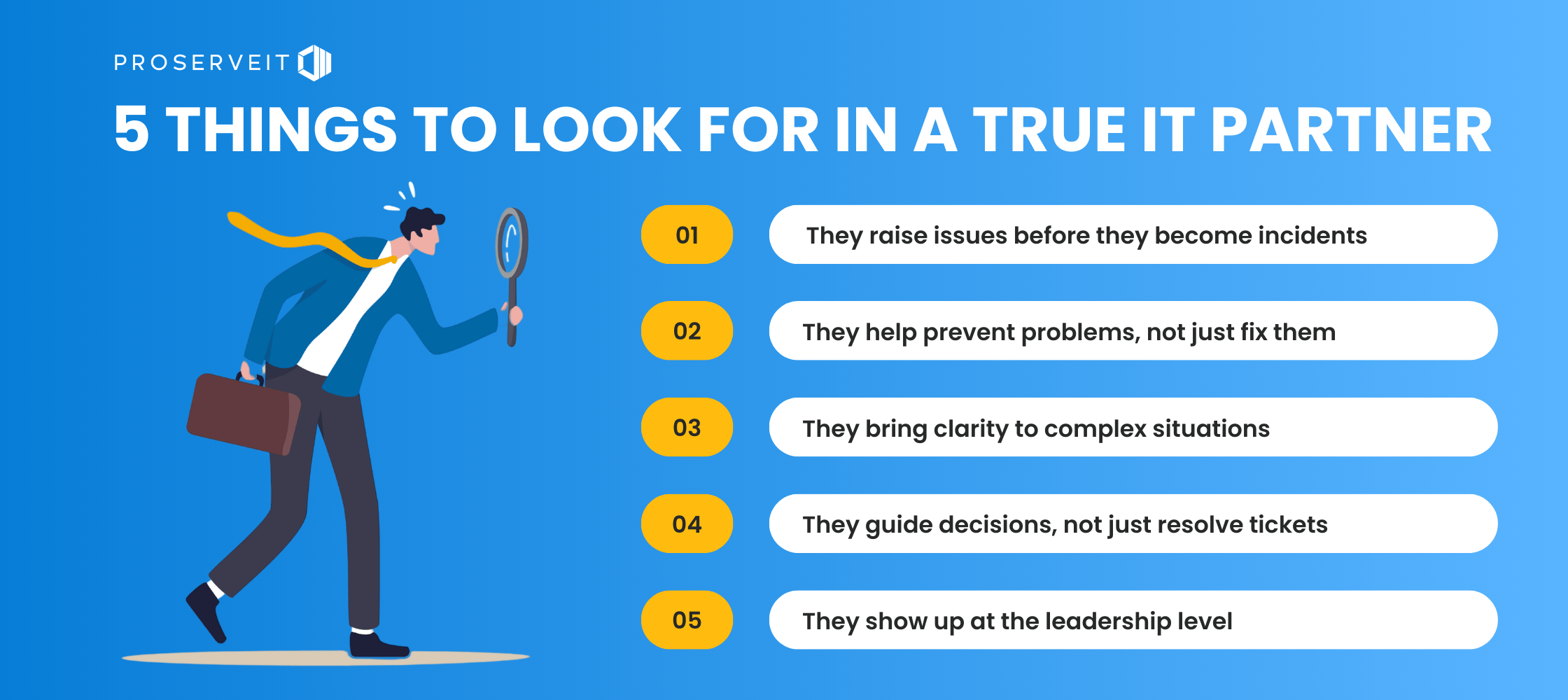
They Lead the Conversation Before Problems Appear
A genuinely proactive IT partner initiates conversations about risk before incidents occur.
They raise potential vulnerabilities, lifecycle concerns, and strategic gaps without waiting for disruption to force the discussion.
Planning conversations extend beyond the immediate quarter and connect infrastructure decisions to broader business objectives, including AI adoption and evolving cybersecurity requirements.
🛡️
They Measure Prevention, Not Just Response
They also measure prevention, not just response.
Mature managed services providers can articulate how they reduce incident frequency over time, how often they assess security posture, and how they track preventive work relative to reactive tickets.
Their reporting reflects forward‑looking insight rather than historical summary alone.
✨
They Communicate With Clarity Under Complexity
Communication is another clear indicator.
In complex environments shaped by AI and rapid change, a proactive partner helps interpret developments rather than overwhelm leadership with technical detail.
They filter signals from noise and provide structured recommendations without creating unnecessary urgency.
🔎
The Relationship Feels Consultative, Not Transactional
The relationship feels consultative rather than transactional.
If discussions revolve exclusively around tickets and tools, the model is likely reactive.
If conversations consistently include risk exposure, strategic alignment, and long‑term planning, the provider is operating proactively and relationally.
💼
Executive‑Level Engagement Is Built In
An IT partner who truly understands and delivers proactive IT support goes beyond deploying a team of technical resources.
They provide executive‑to‑executive alignment.
In addition to engineers and service managers, there is strategic advisory involvement and senior‑level engagement that supports leadership conversations.
This ensures that technology decisions are aligned not only operationally, but strategically and organizationally.
A Strategic Shift
The move from reactive IT support to proactive IT support represents a strategic shift in how organizations manage risk and enable growth.
Adding a human-centered and hospitality-driven layer transforms that shift from operational improvement to partnership evolution.
As automation expands and AI continues to accelerate change, technical capabilities across managed services providers will increasingly converge. What will not converge is the quality of the relationship surrounding those capabilities.
Excellence in managed IT services can no longer be defined solely by what is monitored, secured, or resolved.
It must also be defined by how confidently organizations operate because of the partnership supporting their technology and understanding the role of technology in business strategy and growth.
Proactive IT support reduces disruption. Human-centered hospitality sustains trust. Together, they create a model of managed services built not only for performance, but for resilience in an age of constant change.
Frequently Asked Questions (FAQS)

Mihae Ahn, MBA, is the vice president of Marketing at ProServeIT. She is strongly committed to gender equity and social justice. As a published author and a marketing leader, Mihae expertly balances her professional accomplishments with her roles as a mother, wife, and dedicated lifelong learner. Her passion for making a positive impact shines through both in her career and personal life.


Comments