
Why Managed IT Services Aren't Complete Without Integrated Cybersecurity
Proactive IT Is Now the Baseline
In our previous discussion on proactive IT support versus reactive IT support, we explored why prevention, foresight, and disciplined monitoring are now strategic necessities.
In an era defined by AI acceleration and expanding cybersecurity complexity, reactive models simply cannot keep pace. Proactive IT support reduces volatility, strengthens planning, and enables leadership to operate with greater steadiness.
But there is an additional layer that deserves equal attention: hospitality.
Did that raise your eyebrow? That reaction is understandable. Hospitality is not a word that typically comes to mind when thinking about IT, cybersecurity managed services, or infrastructure strategy.
The Missing Layer in Modern Managed Services
Have you ever felt that proactive monitoring, predictive analytics, and structured lifecycle planning are all in place, yet something still feels missing? That every interaction feels transactional as opposed to a partnership? That your provider is doing their job but does not seem to have your best interest at heart?
Proactive IT support protects systems. Hospitality protects confidence.
That distinction matters more than it may initially appear. It is not about “touchy-feely” concepts that can be dismissed.
Let me elaborate.
.png?width=2240&height=1000&name=How%20Proactive%20IT%20Enables%20Leaders%20(5).png)
In this blog, we’ll explore:
🤝 Why Hospitality in Managed Services Matters
👥 What Hospitality Looks Like for Employees and Executives
⚖️ The Leadership Burden Behind Technology Decisions
🎯 The Employee Experience Is Strategic
❓ FAQs
Why Hospitality in Managed Services Matters
Many managed services providers now market themselves as proactive and strategic.
They highlight continuous monitoring, vulnerability scanning, and structured strategic reviews.
These capabilities are important. However, being proactive and strategic at the infrastructure level does not automatically translate into a strong customer experience in managed services.
When Strategy and Experience Fall Out of Sync
Consider a familiar scenario:
-
Risks are identified early, but they are communicated in technical language that overwhelms executive stakeholders.
-
A potential vulnerability is surfaced, but without business context or prioritization.
-
A lifecycle concern is raised with urgency, but without clarity about financial or operational impact.
You begin to notice a not‑so‑subtle disconnect between technology discussions and business realities.
At the same time, employees hesitate to reach out to the help desk because previous interactions felt rushed or dismissive.
They submit tickets, issues are technically resolved, but they do not feel supported in the process. Over time, they associate IT support with friction rather than assistance.
Technically, the provider is “doing its job.”
-
They close tickets.
-
They monitor systems.
-
They solve issues.
Experientially, leadership feels unsettled and employees feel unsupported.
Would you say your expectations are met? Would you say you are seeing a return on investment? Would you want to continue the relationship? Wouldn’t you want to look for something better?
There is a real business cost to this misalignment.
Where Hospitality Becomes the Differentiator
This is why hospitality in managed services is essential.
Hospitality is not about informality or excessive accommodation. It is about intentional delivery of expertise.
It recognizes that technology conversations intersect with:
-
Leadership pressure
-
Budget accountability
-
Employee productivity
-
Organizational reputation
At its core, technology is about humans. Humans use it. Humans implement it. Humans are accountable for it.
Customer experience in managed services must reflect that reality.
What Hospitality Looks Like for Employees and Executives
Hospitality in managed IT services shows up differently depending on who is experiencing it.
👥
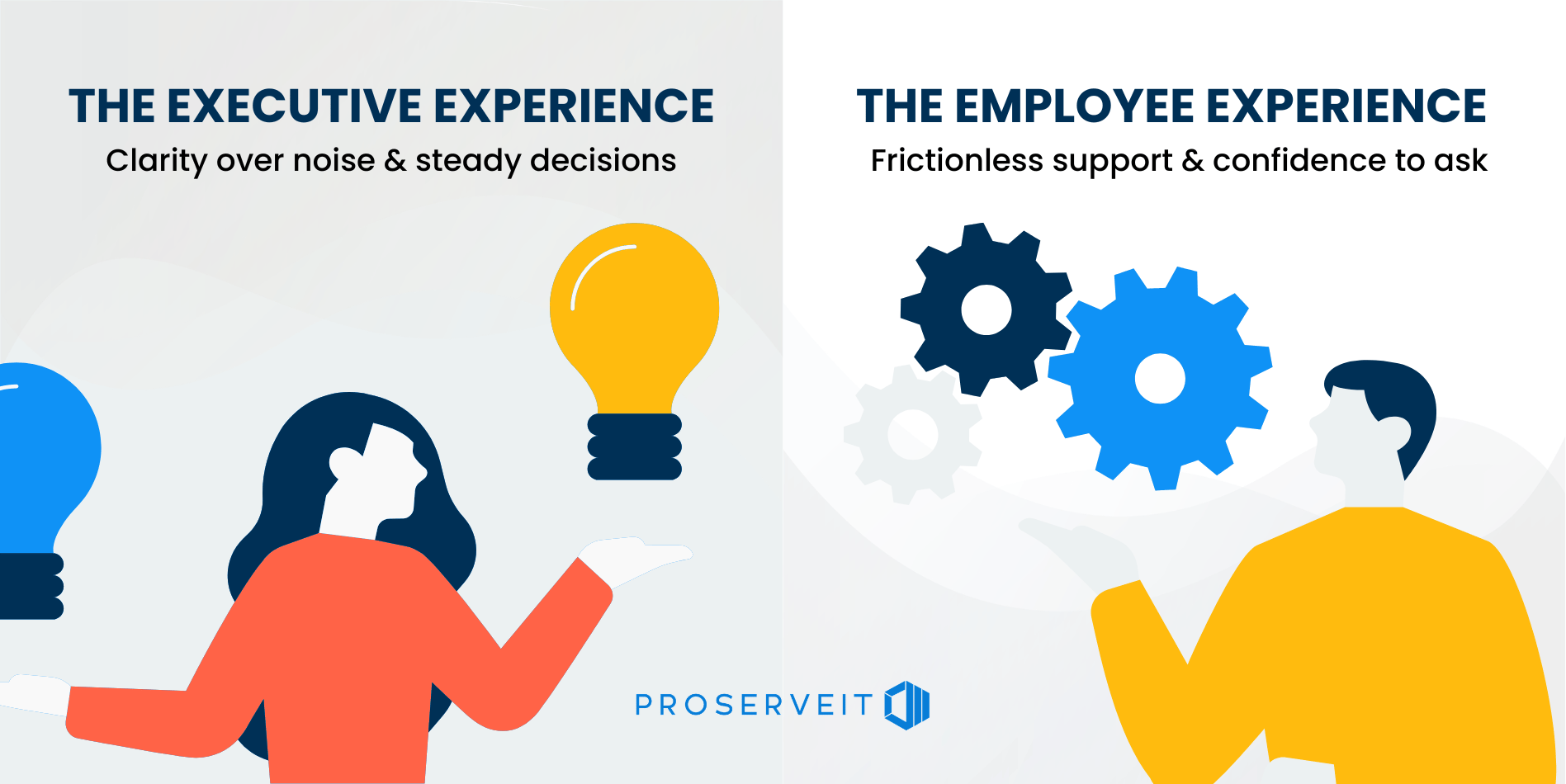
The Employee Experience: Support That Feels Human
For employees, hospitality is felt in everyday interactions.
When they submit a support request, they are acknowledged promptly. Their issue is addressed clearly and respectfully. Explanations are provided in language they understand, not buried in jargon.
In practice, this means employees do not feel:
-
Talked down to or rushed off the phone
-
Like a “case” or a “number”
-
Hesitant to ask questions or raise concerns
Instead, they feel that their work matters and that the support team is genuinely invested in helping them succeed.
When this becomes consistent:
-
Employees are more willing to raise issues early
-
Small problems are resolved before they escalate
-
Technology adoption improves because users feel confident asking questions.
Productivity increases not only because systems function well, but because support interactions are frictionless.
🤝
The Executive Experience: Partnership Beyond Reporting
For executives, hospitality manifests as partnership.
Rather than receiving raw technical updates, leaders experience:
-
Risk conversations framed in business terms rather than purely technical language
-
Security concerns paired with clear remediation paths and prioritized guidance
-
Quarterly reviews that extend beyond ticket counts and system metrics to address forward‑looking strategy, such as AI readiness, cybersecurity posture, and regulatory exposure
In an increasingly noisy and overwhelming world, new developments are filtered and contextualized before they reach your desk.
This reduces noise and highlights what truly requires attention.
⚙️
Operating as an Extension of Your Team
In this model, your managed IT services provider has your best interest at heart. They believe and act as if they are an extension of your team.
They take on a twofold responsibility:
-
Prepare leadership psychologically and strategically for what lies ahead
-
Support employees with empathy so they can do their jobs without unnecessary technology friction
Let’s look at these two angles in more detail.
The Leadership Burden Behind Technology Decisions
For CEOs and executive teams, technology conversations rarely stay confined to IT — and they should not.
Each conversation carries weight beyond the technical layer:
-
A cybersecurity update touches brand protection and regulatory exposure
-
An AI initiative affects workforce planning and operational redesign
-
A cloud migration influences cost structure and investor perception
When communication lacks context, leadership must absorb and interpret fragmented information under pressure.
When risk is presented without prioritization, anxiety increases.
When updates are overly technical, executives are forced to translate implications themselves.
How Hospitality Reduces Cognitive Load
A hospitality‑driven managed services model reduces this cognitive burden when it:
-
Distinguishes between material risk and background activity
-
Provides structured recommendations rather than fragmented alerts
-
Anticipates likely follow‑up questions before they are voiced
This does not soften urgency when urgency is required. It strengthens it by ensuring leaders understand both the risk and the path forward.
Proactive IT support reduces disruption. Hospitality ensures that prevention feels steady rather than overwhelming.
.png?width=2000&height=514&name=ProServeIT%20Managed%20Services%20%20(2).png)
The Employee Experience Is Strategic
Technology affects every employee, not just the IT department.
In high‑growth and AI‑driven environments, employees are already adapting to new systems, new workflows, and evolving expectations.
When IT support feels transactional, small frustrations accumulate. Hesitation to reach out leads to delayed problem resolution. Workarounds develop. Confidence erodes quietly.
How People‑First IT Support Improves Productivity
Conversely, when employees experience human‑centered managed IT services, they:
-
Feel welcomed rather than processed
-
Trust that their concerns will be taken seriously
-
Engage with new tools more openly
-
Surface inefficiencies earlier
This cultural shift reduces hidden operational drag. Productivity improves not only because infrastructure is stable, but because support interactions build trust rather than diminish it.
Customer experience in managed services therefore affects both strategic leadership outcomes and day‑to‑day execution.
Closing Reflection
Technology will continue to evolve. AI capabilities will expand. Cybersecurity risks will grow more sophisticated. Managed services providers will continue refining their monitoring tools and automation capabilities.
What will not standardize is how organizations feel as they navigate this complexity.
Proactive IT support ensures that systems are prepared. Hospitality ensures that people are prepared.
In modern managed IT services, both are required. Systems alone are not enough. The experience surrounding them shapes confidence, productivity, and long‑term resilience.
Customer experience in managed services is no longer secondary to technical capability. It is central to how organizations operate, grow, and lead in an age of constant technological change.
ProServeIT's Standard for Managed IT Services
Our commitment as a managed IT services provider striving to raise the bar is to provide unreasonable hospitality — a concept introduced in the book Unreasonable Hospitality by Will Guidara — to our customers and to become a true partner invested in their business success.
Frequently Asked Questions (FAQS)

Mihae Ahn, MBA, is the vice president of Marketing at ProServeIT. She is strongly committed to gender equity and social justice. As a published author and a marketing leader, Mihae expertly balances her professional accomplishments with her roles as a mother, wife, and dedicated lifelong learner. Her passion for making a positive impact shines through both in her career and personal life.

Comments