

Why Managed IT Services Aren't Complete Without Integrated Cybersecurity
You're working on a presentation that's due EOD...
Suddenly, your screen throws up a cryptic error message. You sigh. After your third password reset this week, and that printer that still refuses to acknowledge Wi-Fi exists, you’re one small incident away from swearing off technology altogether and moving to a deserted island.
Sound familiar?
Yep, most people don’t want to think about IT or technology until something breaks. After all, you're busy running a business, making decisions, closing deals, managing people, and keeping clients happy.
You probably don’t have the time or headspace to untangle server alerts, security patches, and software compatibility issues. You just need things to work.
That’s where managed IT services come in. But what are managed IT services, really? And why are more and more mid-sized businesses leaning on them instead of trying to do it all in-house?
Let’s break it down, plainly, practically, and without the tech jargon.
In this blog, you will find:
🤔 What Does “Managed IT” Really Mean?
🗝️ Key Services Offered by an MSP (Managed Services Provider)
✨ Benefits of an MSP (+ Why It’s Better Than “Break-Fix”)
🏢 Industries That Benefit Most from Managed IT Services
💡 MSP vs. In-House IT: What's Right for You?
🤩 What to Expect from a Good MSP
❓ Frequently Asked Questions (FAQs)
🏁 The Final Word: We Speak Your Language
What Does “Managed IT” Really Mean?
In simple terms, managed IT services mean outsourcing your company's technology management to a team of experts who handle it for you.
Instead of scrambling to fix things after they break, a managed IT provider proactively monitors your systems, keeps them secure and up to date, and makes sure your technology actually supports your business goals, not the other way around.
Think of it as having your own IT department, the expertise, the coverage, the strategic thinking, but without the overhead of hiring, training, and managing a full internal team. No worrying about what happens when your IT person goes on vacation...or leaves entirely.
You'll often hear these providers called an MSP (Managed Services Provider). They typically offer a monthly service package that covers your day-to-day tech support, network monitoring, data backups, cybersecurity protection, and a whole lot more.
But here’s what really matters:
Managed IT isn’t just about fixing problems. It’s about preventing them.
It’s the difference between constantly firefighting, and installing smoke detectors, sprinklers, and fireproof doors before there’s ever a spark.
.png?width=1078&height=385&name=Bigger%20Blog%20Graphics%20(1).png)
💡 Related Reading: The Benefits of Using Managed IT Services
Think of Us Like Your Tech Contractor
Still wrapping your head around what a managed IT provider actually does?
Let’s use a familiar analogy.
Imagine you’re renovating your office. You could hire individual electricians, plumbers, carpenters, and painters yourself, scheduling each one, coordinating timelines, and hoping nothing slips through the cracks.
Or, you could hire a general contractor.
They bring in the right specialists, manage the work, ensure quality, and keep the project moving. You get progress updates and a finished space that actually works.
A managed IT partner plays that same role for your technology.
Instead of juggling separate vendors for cybersecurity, back-ups, helpdesk support, cloud tools, and compliance, you work with one trusted partner who coordinates it all.
Less complexity. Better performance. And when something does go sideways, you’re not left Googling “who do I call when the server starts making that noise?”
Key Services Offered by an MSP (Managed Services Provider)
Not all managed service providers are created equal, but here’s what a well-rounded MSP like ProServeIT typically offers:
✅ 24/7 Helpdesk Support
So your team always has someone to call when the tech isn’t cooperating.
✅ Cybersecurity Monitoring & Threat Response
Detect and stop threats before they become disasters.
✅ Cloud Management & Backups
Ensure your data is safe, accessible, and backed up regularly.
✅ Patch Management & System Updates
Keep everything current, without you having to lift a finger.
✅ Vendor & License Management
No more juggling SaaS renewals or dealing with five different support lines.
✅ Strategic IT Planning & Roadmaps
Make smarter decisions about your tech investments, long before they become issues.
📚 Related Reading: The Role of an IT Consultant in Digital Transformation
Benefits of an MSP (+ Why It’s Better Than “Break-Fix”)
Still relying on the old “call when it breaks” approach? That’s known as break-fix IT, and it’s risky.
Break-fix support is reactive. Problems surface after damage is done.
Managed IT is proactive. Issues are identified and addressed before they disrupt your business.
Think of break-fix like calling the fire department after your building is already on fire.
Managed IT is everything that prevents the fire in the first place.
That's the difference between break-fix IT and managed services, and many businesses are switching to proactive managed IT services these days.
Break-fix IT = downtime, reactive scrambling, surprise bills that stress your CFO out.
Managed IT = stability, prevention, strategic planning, and the ability to sleep soundly knowing someone's watching your systems while you're not.
.png?width=1101&height=283&name=Break-fix%20vs.%20Managed%20IT%20(1).png)
Other key benefits of managed IT services include:
💰 Cost predictability
Fixed monthly pricing instead of surprise repair bills. You can actually budget for IT.
📊 Less downtime
Thanks to proactive monitoring and maintenance, issues are caught early, before they impact your team or your clients.
💥 Fewer internal disruptions
Your teams stay focused on their jobs instead of becoming ad hoc IT support.
☮️ Peace of mind
Knowing someone always has your back, 24/7/365. Security threats don't take weekends off, and neither does your support team.
👩🔬 Access to real expertise
Cloud specialists. Cybersecurity experts. Compliance gurus. People who live and breathe this stuff and can help with your digital transformation. It's like having a whole IT department's worth of knowledge for a fraction of the cost.
💡 Want more insights? Explore resource-efficient strategies for digital transformation
Industries That Benefit Most from Managed IT Services
While any business can benefit from managed IT support, certain industries face unique technology challenges that make partnering with an MSP especially valuable.
Think of it like this: everyone needs transportation, but a delivery company needs something very different from what a luxury car service needs. Same basic function, wildly different requirements.
Here's how managed services address the specific needs of key sectors:
🩺
Healthcare & Medical Practices
Healthcare organizations don’t get the luxury of “we’ll fix it tomorrow.”
Between strict compliance requirements, highly sensitive patient data, and systems that need to be available at all times, IT issues quickly turn into real-world consequences.
An MSP helps ensure systems stay secure, compliant, and reliable, so providers can focus on patient care instead of wondering whether the EHR system will cooperate today.
🏭
Manufacturing
In manufacturing, when systems go down, so does the production line.
Modern manufacturers rely on a mix of operational technology (the systems that actually run equipment) and traditional IT systems for inventory, scheduling, and supply chains. When those environments aren’t aligned, downtime spreads fast, and gets expensive even faster.
An MSP helps keep production systems online, protects against ransomware that could halt operations entirely, and ensures your technology supports output instead of slowing it down.
🏗️
Construction & Engineering Firms
For construction and engineering teams, the office isn’t just one place, it’s wherever the job site happens to be that day.
Your teams need secure access to drawings, specifications, and collaboration tools whether they’re in headquarters, on a site trailer, or standing in a muddy field with spotty reception.
An MSP ensures your tools stay accessible, your data stays protected, and your mobile workforce can work without fighting technology at every step.
Think of it as building a digital infrastructure that's as solid as the physical ones you create.
🗃️
Legal & Professional Services
Legal and professional services firms live at the intersection of confidentiality and time.
You’re handling highly sensitive information under strict ethical obligations, and every hour of downtime is literally billable time disappearing.
An MSP delivers enterprise-grade security, secure document sharing, and reliable access to practice management systems so your team can work confidently and without interruption.
💵
Financial Services
Financial organizations are under constant pressure from regulators, from cybercriminals, and from clients who expect seamless digital experiences.
Downtime here doesn’t just cost money. It risks trust.
An MSP provides advanced threat detection, compliance support, secure infrastructure for financial transactions, and business continuity planning that ensures operations keep moving, even when something goes wrong.
When you manage money for a living, security can’t be optional.
💗
Nonprofits & Charitable Organizations
Nonprofits face a unique challenge: enterprise-level technology needs with nonprofit-level budgets.
You need systems that are secure, reliable, and compliant, especially when handling donor data, but every dollar spent on IT is a dollar not spent on your mission.
An MSP helps nonprofits maximize the value of donated or discounted tools (like Microsoft 365 for Nonprofits), keeps donor and constituent data protected, and frees up staff to focus on impact instead of IT emergencies.
Technology should amplify your mission, not compete with it.
What These Industries Have in Common
They all rely heavily on technology.
They all face real consequences when it fails.
And they all need expert support without the overhead of building a full internal IT department.
That’s exactly where managed IT services deliver the most value.
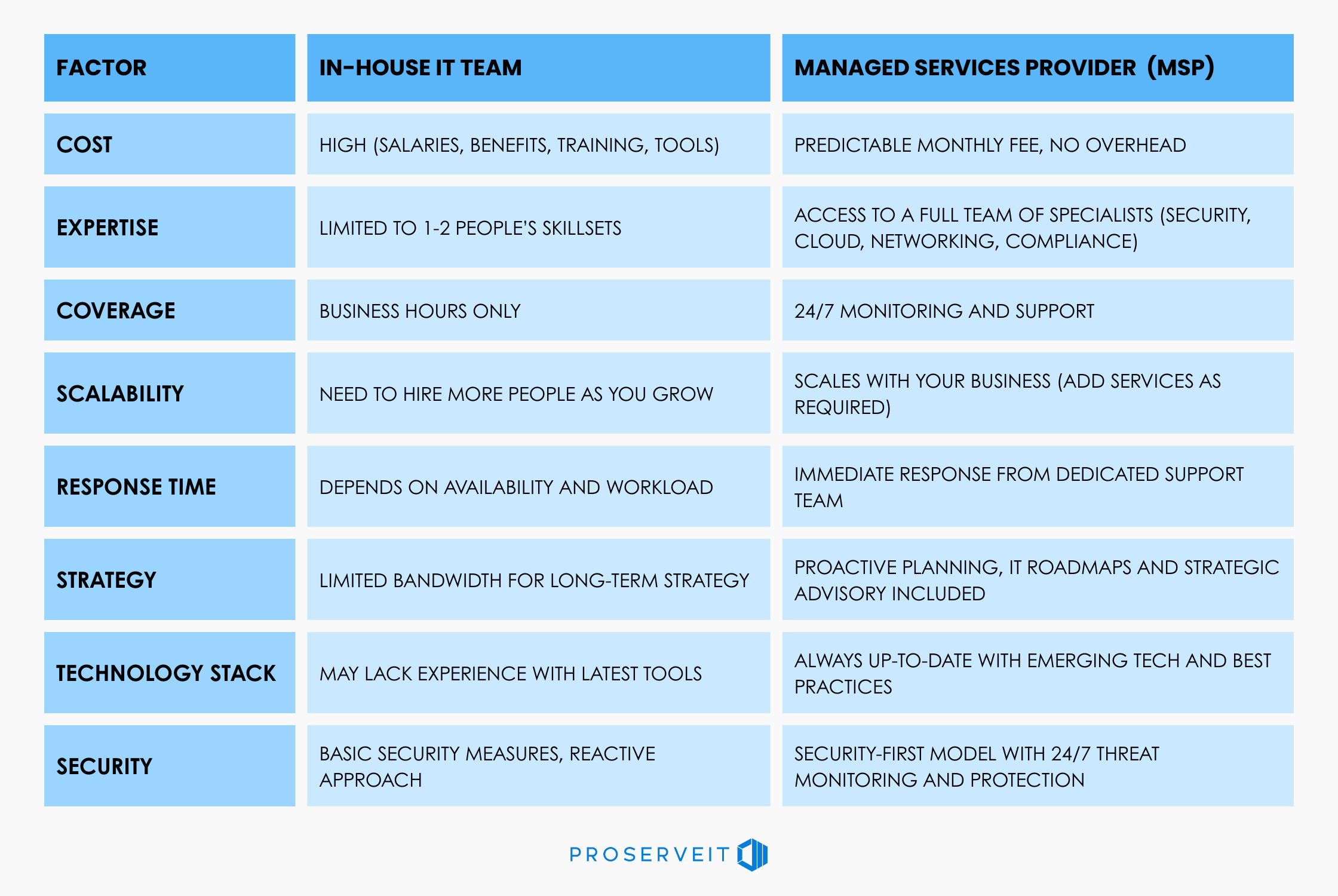
MSP vs. In-House IT: What's Right for You?
One of the most common questions people ask is: "Should we hire an in-house IT person or work with an MSP?" It's a fair question, and honestly, the answer depends on your business size, complexity, and goals.
Think of it like this...Some companies need a full-time mechanic in the garage because they’re running a fleet of highly specialized vehicles, every day, all day. Others just need a trusted service team that keeps everything running smoothly — and is available the moment something feels off.
When In-House IT Makes Sense
In-house IT works best when technology is deeply custom, constantly evolving, and tightly woven into daily operations.
You may lean toward in-house IT if:
-
You’re a large organization with complex, highly specialized systems
-
You require constant on-site presence
-
You have the budget to build a true team, not just one person wearing five hats
-
You’re prepared for ongoing training, coverage gaps, and knowledge transfer risks
In-house teams can offer deep familiarity with your environment. But they’re also limited by time, bandwidth, and the reality that no single person can be an expert in everything anymore.
When an MSP Makes Sense
An MSP is designed for organizations that rely heavily on technology, but don’t want technology management to become their core business.
You may benefit from a Managed Service Provider like ProServeIT if:
-
You’re a small to mid-sized organization without the budget for a full IT department
-
You need 24/7 coverage, not just business-hour support
-
Security, compliance, and uptime matter, even when no one’s watching
-
Your internal IT person is stretched thin and constantly reacting
-
You want predictable costs and fewer surprises
Working with an MSP is like having a deep bench instead of a single player. Security specialists. Cloud experts. Compliance pros. All available when needed, without hiring them individually.
For many organizations, the smartest move isn’t choosing one or the other.It’s using an MSP to extend, stabilize, and support what you already have.
7 Signs You Need an MSP
Not sure if managed IT services are right for your organization? Let's run through a quick diagnostic. Here are the warning signs that it's time to bring in expert support:
🚩
1. Your Team Is Constantly Interrupted by IT Issues
If your operations manager is rebooting servers, your finance lead is playing tech support for printer problems, or your "tech-savvy" employee has accidentally become the unofficial IT department, you've got a problem. And it's not just annoying, it's expensive.
Think about it this way: you hired talented people to do specific jobs. Every hour they spend troubleshooting why emails won't send is an hour they're not doing the work you actually need them to do.
It's like hiring a surgeon and then asking them to also mop the floors. Sure, they could do it, but is that really the best use of their skills?
🚩
2. You're Experiencing Frequent Downtime
When your systems go down regularly, or mysterious issues keep popping up like an endless game of whack-a-mole, it's a sign that your IT environment isn't being properly monitored or maintained.
Downtime doesn't just frustrate your team. It costs you real money, damages client relationships, and puts your data at risk. Every minute your systems are down is a minute your competitors are still running.
It's like trying to win a race with a car that keeps stalling. Eventually, everyone else laps you.
🚩
3. You're Worried About Cybersecurity (But Don't Know Where to Start)
Ransomware. Phishing attacks. Data breaches. These aren't just problems for Fortune 500 companies anymore. Small and mid-sized businesses are actually more attractive targets because hackers know they typically have weaker defenses.
If you're lying awake at night wondering whether your backups actually work, whether your passwords are strong enough, or what would happen if someone clicked that sketchy email, you're not alone.
Cybersecurity should be the foundation of your technology framework, just like a house needs a solid foundation to stand on. An MSP brings the expertise and 24/7 monitoring that most small IT teams simply don't have.
🛡️ Related Reading: What Is IT Security & Why It Matters More Than Ever
🚩
4. You're Relying on Break-Fix IT Support
Calling someone only when something breaks might feel cost-effective, but it's actually the opposite.
Break-fix IT is reactive, unpredictable, and expensive. You're paying emergency rates to fix problems that could have been prevented with proactive monitoring and maintenance. Plus, you're dealing with the chaos and lost productivity that comes with every fire drill.
🚩
5. Your IT Costs Are Unpredictable
Surprise bills for repairs. Emergency support calls at premium rates. Unexpected hardware replacements that weren't in the budget. If your IT spending feels like a financial mystery novel where you never see the plot twist coming, managed services offer the predictability you need.
Fixed monthly costs mean you can actually budget. Imagine that.
🚩
6. You're Planning to Grow (Or Already Struggling to Scale)
Whether you're opening a new location, hiring rapidly, or adding new tools to your tech stack, growth puts serious pressure on your IT infrastructure. And if your systems can't keep up with your ambitions, your technology becomes a boat anchor instead of a rocket booster.
An MSP helps you scale smoothly, without the growing pains of figuring it all out yourself or realizing six months in that your infrastructure can't handle the load.
🚩
7. You Don't Have a Long-Term IT Strategy
Are you making technology decisions reactively? Buying tools as needs pop up without any kind of roadmap? Unsure how your current systems will support your business goals over the next few years?
That's like going on a road trip without a map, GPS, or any sense of which direction you're supposed to be heading. You might eventually get somewhere, but it probably won't be where you wanted to go, and you'll waste a lot of gas along the way.
An MSP doesn't just keep things running, they help you plan for what's next.
If you checked off two or more of these signs, it's worth having a conversation about managed IT services.
What to Expect from a Good MSP
If you're shopping around for an MSP, here’s what you should expect from a quality partner:
💬 Clear Communication
A good MSP explains things in plain English, not technical jargon. Their job is to make technology understandable, and you should always know what's happening with your systems and why it matters to your business.
🤝 Fast, Friendly Support
24/7 support only matters if you can actually reach someone when you need them. Look for dedicated support teams who know your business and respond with genuine urgency.
🛡️ Security-First Mindset
Security should be baked into everything, monitoring, updates, back-ups, user access. Not an add-on you pay extra for, but a fundamental part of how they operate.
🚀 Scalability
Your business will change. A quality MSP builds solutions that grow with you, whether you're adding users, opening new locations, or adopting new technology.
💡 Proactive Strategy
The best MSPs don't just fix your tech, they help you use it better. They bring ideas to the table, suggest improvements, and look ahead at where your business is going.
📋 Experience
An MSP that's worked with businesses like yours already understands your challenges, compliance requirements, and the technology that actually works in your space.
👁️🗨️ Transparency
No buried clauses or surprise bills. Good MSPs are upfront about what's covered in your monthly fee and what costs extra.
At ProServeIT, we're built for modern businesses with lean or overworked IT teams. Whether you're the sole "IT person" or have a small tech staff juggling everything or are a larger organization that needs a highly experienced MSP to match your complex needs, we provide the support and stability you need to boost your IT strategy confidently.
Our goal is simple: make your employees feel confident in the technology they use. When your team trusts their tools and knows help is always available, productivity soars and technology becomes a true business enabler instead of a source of frustration.
💡 Related: Why IT Strategy Matters: Aligning Technology with Business Goals
Frequently Asked Questions (FAQs)
The Final Word: We Speak Your Language
You don’t have to become a tech expert overnight. And you don’t have to manage it all alone.
Managed IT services exist so that your operations can run smoothly, your team can stay focused, and your business can move forward with less stress and more support.
👉 Learn more about our Managed IT Services
Whether you need someone to take over the daily helpdesk grind, build your long-term IT roadmap, or handle cybersecurity from end to end, we’re here to make IT feel simple again.
Let technology work for you, not against you. Let's build a smarter, safer, more manageable IT environment, together.

Kaavya is a creative enthusiast at ProServeIT, with a passion for writing, designing, and storytelling. As a marketer with a strong foundation in copywriting, she brings a unique blend of creativity and strategic insight to her role, helping to craft compelling content that aligns with ProServeIT’s mission.



Comments